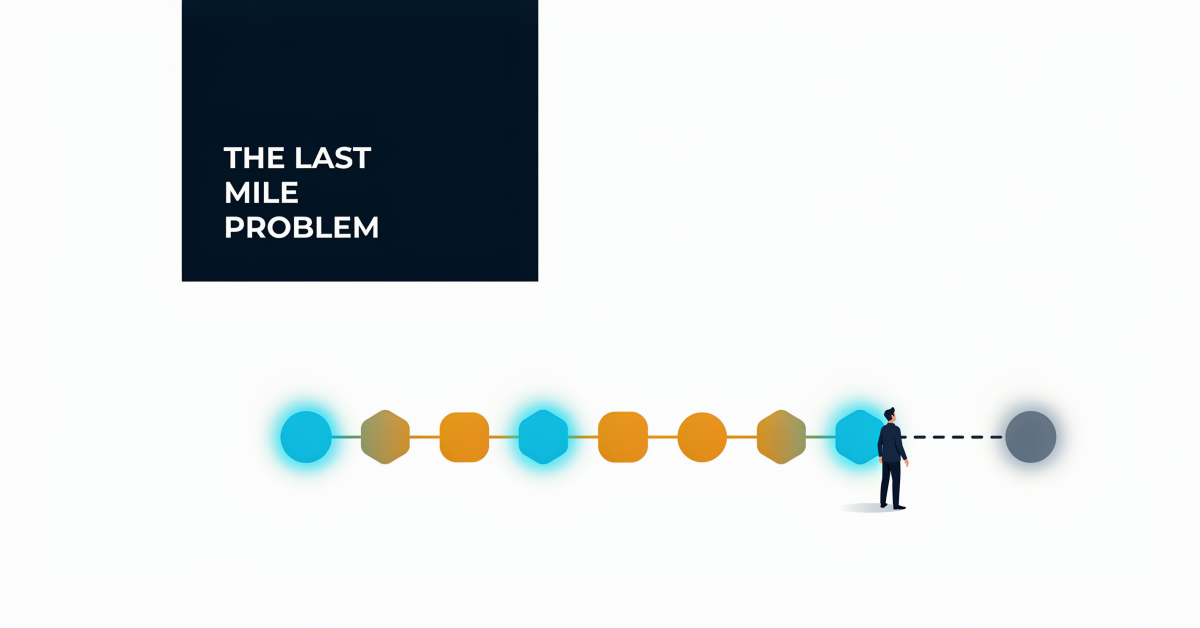
The Model Isn't the Problem. The Last Mile Is.
Enterprise AI keeps improving — yet returns still trail spending. The gap lives in the workflows where revenue and risk actually happen.
Enterprise AI is not failing because the models are bad. By most measures, model capability has outpaced deployment maturity for two years running. Reasoning is sharper, context windows are longer, and inference costs have fallen dramatically. And yet a consistent finding persists across enterprise deployments: the returns still trail the spending. Capability is not the bottleneck. Something else is.
That something is increasingly being called the last-mile problem — the gap between a working AI system and the business process where that system's output would actually matter. Revenue lives there. Risk lives there. So does the decision-making that determines whether a company moves faster or slower than its competitors. When AI stops short of that threshold, it produces dashboards and demos rather than outcomes.
Where AI Actually Stops
The pattern is familiar to anyone who has run an enterprise AI programme past the pilot stage. A model performs well in a controlled environment. It handles the test cases. Stakeholders are encouraged. Then it moves toward the real workflow — the one connected to customers, to compliance records, to operational handoffs that happen under time pressure — and the integration complexity multiplies. The model's outputs need to be verified before they can act. The process has edge cases no one documented. The system of record wasn't designed to receive instructions from an autonomous agent.
At each of those friction points, the temptation is to add a human check. A human check becomes a queue. A queue becomes the new bottleneck. The AI is technically in production, but it is not in the workflow in any meaningful sense. It has been domesticated into a recommendation engine, which is a useful thing — but not the thing that justifies the investment narrative.
This is the gap that is now reshaping how serious enterprises measure AI success. Throughput on a benchmark is not a business metric. What matters is whether the AI changes how a workflow executes — and whether that change shows up in cost, speed, quality, or revenue.
The Architecture Question Underneath
Closing the last-mile gap is not primarily a model selection problem. It is an architecture and governance problem. The questions that matter are: What decisions can this agent make autonomously, and under what conditions does it escalate? How does it connect to the systems of record that hold the ground truth? What happens when its output is wrong, and how quickly can that be detected and corrected?
The gap between a capable AI system and a mission-critical one is almost always a governance gap, not a model gap.
These questions are uncomfortable because they require an honest assessment of process maturity before AI enters the picture. A workflow that is poorly defined or inconsistently executed in human hands does not become reliable when an AI agent is dropped into it. In many cases, the process needs to be documented and stabilised first — which is unglamorous work that sits upstream of any model deployment. Organisations that skip this step tend to discover it expensively, after deployment, when failure modes surface under production load.
The answer is not to avoid autonomous agents. It is to scope them precisely — to define a bounded decision space where the agent operates with confidence, where its actions are auditable, and where escalation paths are built in from the start rather than bolted on after a failure. Scoped agents with governed autonomy consistently outperform broad autonomous deployments in production environments, not because they do less, but because they do their defined task reliably enough to be trusted with real workflow responsibility.
Measuring Against the Right Benchmark
Enterprises that are closing the last-mile gap share a common shift in how they frame success. They stop measuring AI performance against model benchmarks and start measuring it against process outcomes: cycle time, error rate, escalation frequency, revenue per interaction, cost per resolved case. These metrics force the question of whether the AI is genuinely embedded in the workflow or merely adjacent to it.
That shift also changes what gets prioritised at the architecture level. If the metric is process outcome, then data quality, integration depth, and handoff reliability matter more than model sophistication. An agent is only as capable as the data it operates on — and in mission-critical workflows, that data is often fragmented, inconsistently structured, or locked inside systems that were never designed for programmatic access. Solving that problem is less exciting than evaluating the latest model release, but it is where the actual returns are unlocked.
The enterprise AI payoff is real. But it does not arrive at the model layer. It arrives at the moment an autonomous agent executes a consequential task — booking, intake, qualification, escalation, follow-up — inside the workflow that actually drives the business, not adjacent to it. Organisations that close that last mile, carefully and deliberately, are the ones that will show the numbers that justify the investment.
Further Reading: siliconangle.com
Ready to Put Agentic AI to Work?
See how autonomous AI agents can handle booking, intake, and follow-up for your business.