Capabilities Are Up. Returns Are Not. Something Is Missing.
Enterprise AI is reaching production — just not the workflows where revenue and risk actually live. That gap is now the defining problem.
Enterprise AI spending continues to climb, model benchmarks keep improving, and production deployments are no longer rare. Yet a stubborn pattern persists: the returns trail the investment by a margin that is difficult to explain through capability alone. The technology is present. The value is not arriving where it was promised.
The explanation, increasingly, is not the model. It is the distance between where AI is deployed and where decisions, revenue, and risk actually live.
The Gap Between Capability and Consequence
There is a meaningful difference between AI that works and AI that works inside a mission-critical workflow. A model can summarise documents accurately. A conversational agent can handle routine queries. An automation layer can route tasks between systems. These are real capabilities — but they only generate real returns when they are woven into the processes that determine outcomes: appointment conversion, claim adjudication, intake qualification, customer retention.
When AI stops short of those processes — sitting adjacent to them rather than inside them — it tends to produce outputs that humans still have to act on manually. The efficiency gain is partial. The risk of information dropping between the AI layer and the operational layer is real. And the measurement problem compounds: if AI is not embedded in the workflow, it is genuinely difficult to attribute a business outcome to it.
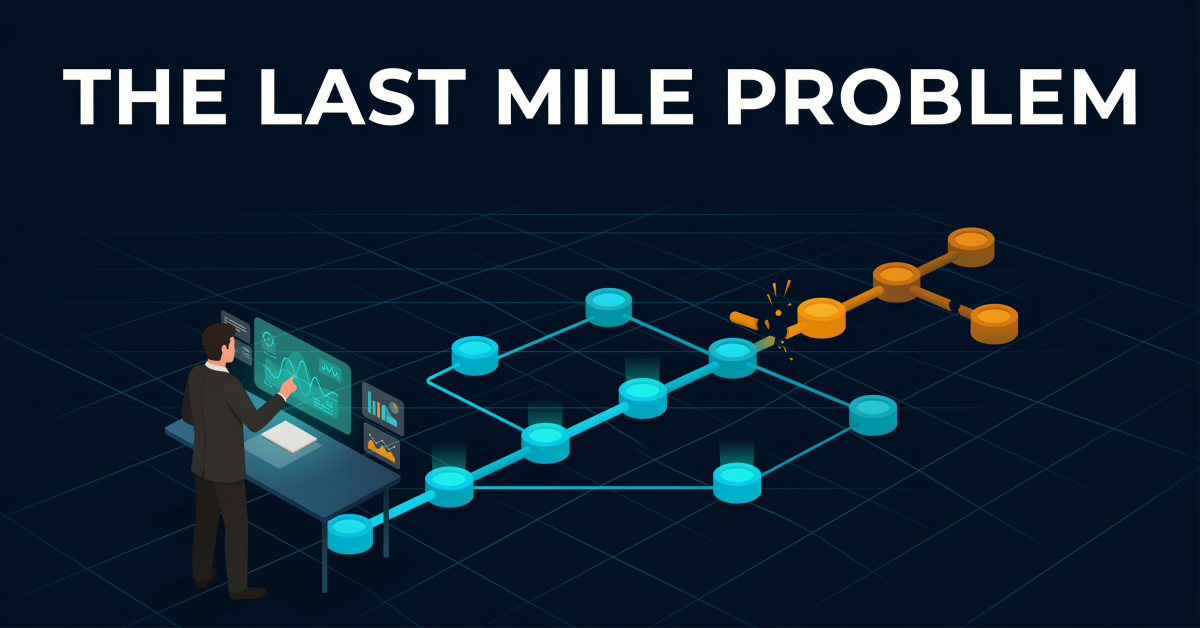
This is the last-mile problem. It is not a model problem. It is an integration, governance, and workflow-design problem — and it is where most enterprise AI programmes currently stall.
Why the Last Mile Is Harder Than the Model
Deploying a capable model is, at this point, a largely solved engineering challenge. The harder work begins when that model needs to take consequential action: updating a record, confirming a booking, escalating a case, or declining a request. At that point, the questions shift from "can the model do this?" to "should the model do this autonomously, and under what conditions?"
The last mile is not a model problem. It is a governance problem dressed up as an integration problem.
Answering those questions requires a governance architecture that most organisations have not yet built. It requires clarity on which decisions an agent can close without human review, which require a handoff, and what happens when the agent encounters a situation outside its defined scope. Without that architecture, the safest organisational response is to keep AI one step removed from the consequential action — which is precisely what produces the capability-without-returns pattern.
This is why the enterprises seeing genuine AI payoff tend to be those that treat workflow redesign and agent governance as the primary work, with model selection as a secondary consideration. As explored in the context of scoped agents and governed autonomy, constraining what an agent can act on is not a limitation — it is the design choice that makes autonomous action trustworthy enough to deploy where it actually matters.
Closing the Gap in Practice
For businesses running autonomous agents, the last-mile question translates into a concrete design challenge: at which step in the workflow does the agent hand off, and on what basis? That boundary is not fixed — it should be governed, monitored, and adjusted as confidence in the agent's performance accumulates.
An AI voice agent handling inbound enquiries, for instance, creates measurable value only when it can complete the booking, capture the intake detail, or qualify the lead — not merely initiate the conversation and pass a transcript to a human. The completion step is the last mile. Everything before it is infrastructure.
The broader implication is that enterprises measuring AI success by model performance or deployment volume are measuring the wrong things. The question that determines ROI is simpler and harder: how far into the consequential workflow does the agent actually go, and how reliably does it perform there? Until that question is answered with data — not intention — the gap between AI capability and AI payoff will remain exactly where it is today.
Further Reading: siliconangle.com
Ready to Put Agentic AI to Work?
See how autonomous AI agents can handle booking, intake, and follow-up for your business.