The Loan Officer Didn't Disappear. The Bottleneck Did.
Agentic systems are entering consumer lending — not to replace human judgment, but to eliminate the workflow gaps that slow it down.
Consumer lending is one of the more consequential places to deploy an autonomous agent. A miscalculation doesn't produce a slightly wrong answer — it affects someone's ability to buy a home or finance a business. That's precisely why the design philosophy behind OutSystems' new Agentic Loan Applications offering is worth examining closely. It's a case study in what responsible agentic deployment actually looks like at the infrastructure level.
What the Architecture Is Actually Saying
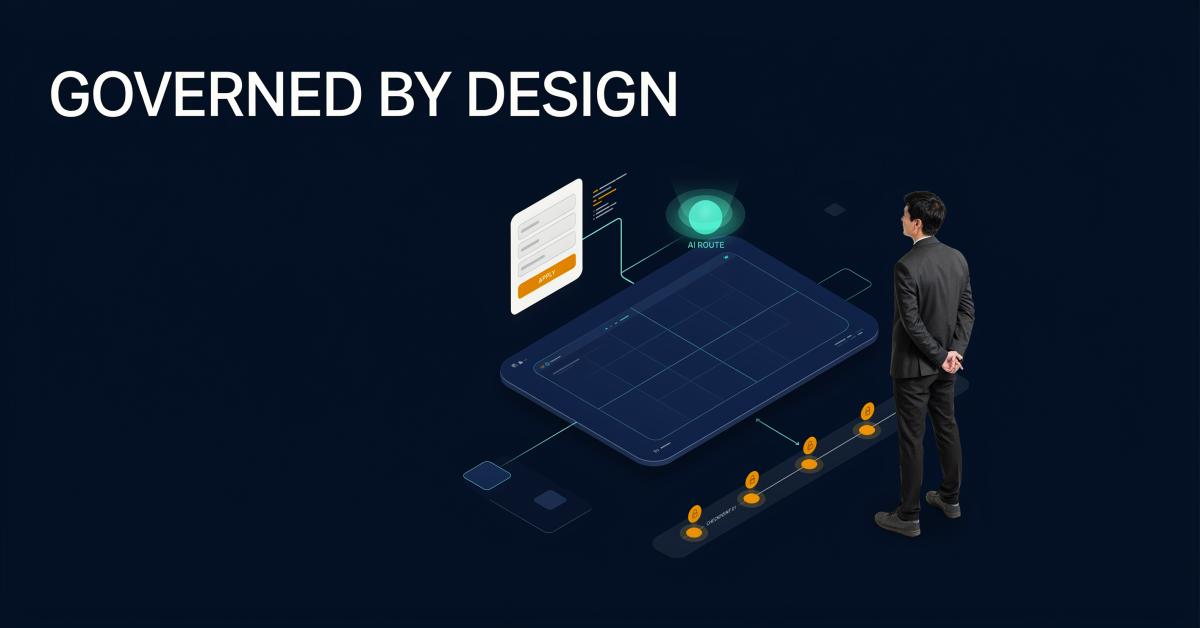
OutSystems' platform sits on top of a bank's existing core systems rather than replacing them. Customer-facing applications, governed agents, and deterministic workflows are unified in a single adaptable layer — which means the agents operate within defined boundaries, not as open-ended autonomous actors.
That distinction matters. Deterministic workflows are not a constraint bolted on as an afterthought; they're structural. The agent can reason and adapt within a process, but the process itself is anchored. This is the architecture pattern that separates production-ready agentic systems from pilot-grade experiments that look impressive in a demo but collapse under edge-case volume.
Deterministic workflows aren't a constraint bolted on after the fact — they're the architecture. That's the difference between a demo and a deployment.
The practical effect is that a bank doesn't have to choose between modernising its lending experience and maintaining regulatory defensibility. The governed layer handles the compliance surface; the agent handles the adaptive reasoning that would otherwise require a human intermediary at every step.
Why 'On Top Of' Is the Right Default
One of the persistent failure modes in enterprise AI is the assumption that transformation requires replacement. Rip out the core banking system, migrate everything, start fresh. This approach routinely stalls — not because the vision is wrong, but because the transition risk is enormous and the timeline extends far beyond any credible planning horizon.
The layered model OutSystems is using sidesteps this entirely. It treats existing infrastructure as a constraint to work with rather than a problem to eliminate. Agents connect to the systems of record already in place, which means data lineage is preserved, audit trails remain intact, and the institution doesn't have to freeze operations during a multi-year migration.
For businesses deploying autonomous agents — whether in lending, client onboarding, or any other process-intensive domain — this is a useful principle. Getting the foundation right matters more than moving fast. An agent running on shaky data infrastructure, or operating outside a defined workflow, creates liability rather than value.
Governance as a Feature, Not a Friction Point
The framing of 'governed agents' in OutSystems' announcement is significant. In early agentic AI discourse, governance was often positioned as the thing that slowed adoption — the compliance layer that procurement and legal teams imposed on an otherwise ready technology. That framing is inverting.
Institutions with the most to lose from an agent error — and consumer lending is clearly in that category — are now treating governance not as friction but as the feature that makes deployment possible at all. Without a clear accountability structure, without explainable decision logic, without deterministic guardrails around the high-stakes moments, a lender simply cannot put an autonomous agent in front of a credit decision.
The same logic applies across any deployment where an agent's output has real consequences for a real person. Scoped, governed agents consistently outperform open-ended autonomous ones — not because ambition should be constrained, but because defined scope is what allows trust to accumulate incrementally. A well-scoped agent that performs reliably earns the expanded mandate. An overreaching one earns a shutdown.
The OutSystems announcement reflects a broader maturation in how agentic AI is being built for regulated industries. The question for any business considering autonomous agents in a consequential workflow isn't whether the technology is capable enough — it increasingly is. The question is whether the governance architecture surrounding it is robust enough to make capability trustworthy.
Further Reading: fintech.global
Ready to Put Agentic AI to Work?
See how autonomous AI agents can handle booking, intake, and follow-up for your business.