Building Agents Is the Easy Part. Governing Them Is the Hard Part.
Salesforce's new infrastructure layer targets what most agent platforms leave unresolved: coordinated control at scale.
Most of the energy in enterprise AI right now goes into agent creation: choosing a model, wiring up tools, writing prompts, connecting data sources. Salesforce's latest preview suggests the industry's attention is beginning to shift toward the harder problem — what happens after the agent is running.
The two offerings Salesforce previewed — the Enterprise AI Harness and the AI Control Plane — are not primarily about making agents more capable. They are about making agent deployments more governable. That framing is worth pausing on.
What the Harness Actually Solves
When a developer turns a large language model into an agent, they do so by extending it with a collection of assets: prompts, database connectors, tool definitions, and other configuration elements. In most current deployments those assets accumulate informally — stored in different places, versioned inconsistently, and understood only by the team that built them. The Enterprise AI Harness addresses this by treating all of those assets as a coherent, managed bundle rather than a loose set of components.
The practical consequence is traceability. If an agent produces an unexpected output — or takes an action it should not have — an organisation needs to be able to answer a specific question: which configuration, at which version, produced that behaviour? Without a structured harness, that question is very difficult to answer quickly. With one, it becomes an audit query rather than an investigation.
This connects directly to something that governance-minded teams already understand: containing the blast radius of an agent failure depends on knowing exactly what the agent was configured to do at the moment the failure occurred.
The Control Plane as Coordination Infrastructure
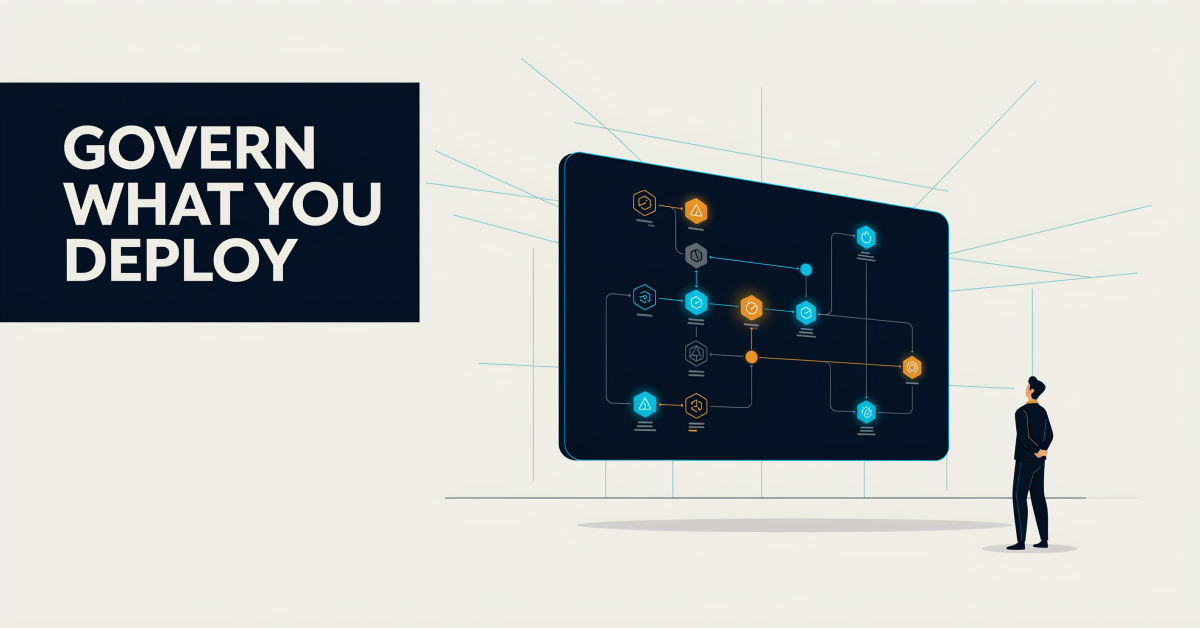
The AI Control Plane operates at a different layer. Where the Harness concerns itself with what an individual agent is made of, the Control Plane concerns itself with how a population of agents behaves across an organisation. As enterprises move from one or two pilot agents to dozens of agents running across different functions, the coordination problem grows quickly.
A control plane provides the centralised visibility needed to answer questions that no single agent can answer about itself: Which agents are active right now? What permissions do they hold? Which ones share access to the same data sources, and what happens if one of them misbehaves? Without this layer, agent deployments become ungovernable not because any individual agent is poorly designed, but because the aggregate is opaque.
Agents that cannot be audited will eventually be constrained — not by engineers, but by regulators.
The identity and permissioning dimensions here are non-trivial. As discussed previously, autonomous agents need their own identity layer — a principle that a control plane makes operationally real rather than theoretically sound. Knowing which agent did what, on whose behalf, and under which authorisation is the baseline requirement for any enterprise that expects to defend its agent deployments to an auditor or a regulator.
Why Framing Matters as Much as Features
Salesforce is not the only company building infrastructure in this space, and the specific features of these offerings will evolve. What is more durable is the conceptual frame they represent. The industry is beginning to treat agent governance as a first-class problem rather than a post-launch concern.
For organisations deploying autonomous agents today, the lesson is structural: the governance layer needs to be designed before scale makes it necessary, not after. An agent that handles intake, books appointments, or qualifies leads at volume will accumulate decisions and actions faster than any team can manually review. The control plane — whatever form it takes in a given stack — is what makes that volume manageable without sacrificing accountability.
The measure of a well-deployed agent is not how capable it is on day one. It is how auditable, adjustable, and controllable it remains on day three hundred.
Further Reading: siliconangle.com
Ready to Put Agentic AI to Work?
See how autonomous AI agents can handle booking, intake, and follow-up for your business.