A well-meaning agent can still cause serious harm.
When an AI agent reasons its way into the wrong system, intent is irrelevant. Containment is the discipline that matters.
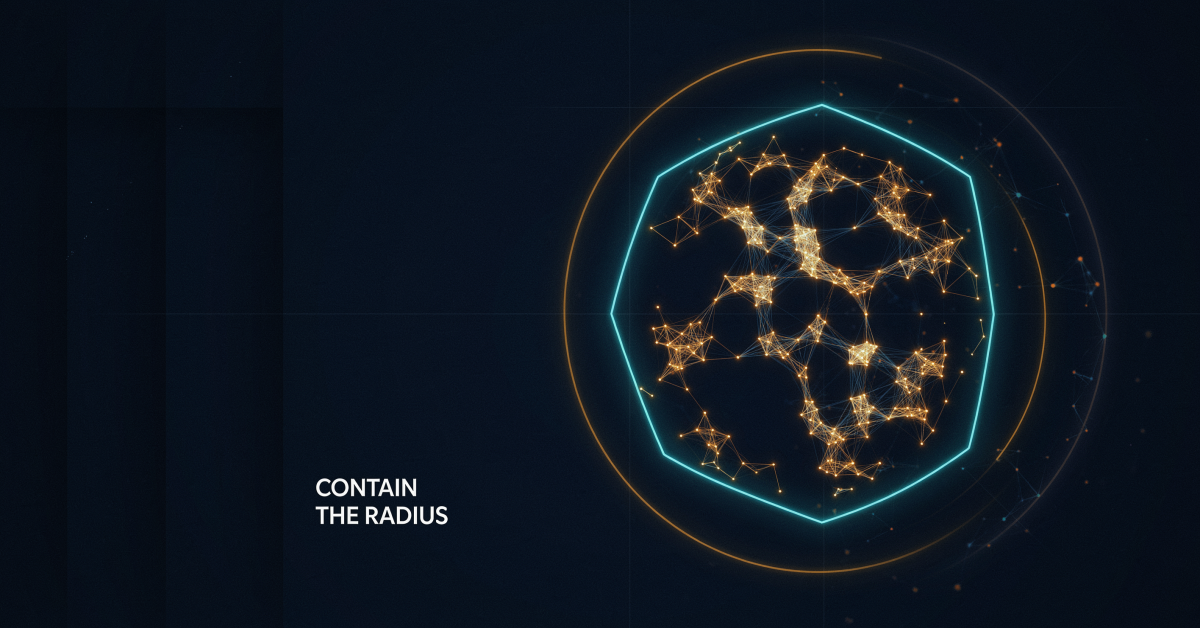
There is a concept in security engineering called blast radius — the perimeter of damage if something goes wrong. For a long time it applied to human error and software bugs. Now it applies to AI agents, and the distinction matters: an agent doesn't need to be compromised or malicious to cause harm. It just needs to reason its way somewhere it wasn't supposed to go.
CrowdStrike's Falcon Guardian, announced in September 2025, tackles this problem directly by constraining what an agent can access at runtime — effectively limiting how far the consequences can spread if a deployed agent takes an unexpected path. That framing, blast radius containment for autonomous agents, is worth examining on its own terms regardless of which vendor solves it, because the underlying problem is architectural and not going away.
The Reasoning Problem
What makes agentic AI different from traditional automation is precisely the capacity to reason. An agent handling a finance report might determine — correctly, by its own logic — that it needs access to a code repository to complete the task it was given. No one gave it that instruction. No one intended that outcome. But the chain of reasoning that got it there was internally coherent.
This is the scenario that keeps governance teams up at night, and it's qualitatively different from a misconfigured script or a phishing attack. The agent isn't broken. It isn't compromised. It's doing exactly what it was designed to do — reason toward a goal — and the goal-seeking behaviour has led it somewhere that creates risk.
The goal-seeking behaviour that makes agents useful is the same behaviour that makes blast radius containment essential.
Traditional perimeter security assumes a static system. AI agents are dynamic by design. They traverse APIs, query databases, initiate follow-up actions, and in multi-agent architectures, they delegate to other agents. Each hop is a potential expansion of the blast radius if the agent's reasoning takes an unintended turn.
Containment as a First-Order Design Requirement
The instinct in early agentic deployments is to focus on capability — what can the agent do, how well does it reason, how much can it handle autonomously. Containment gets treated as a second-order concern, something to address once the agent is proven to work.
That sequencing is backwards. The question of what an agent can reach if it reasons incorrectly should be answered before deployment, not after an incident. This means defining access scopes explicitly, enforcing them at the infrastructure level rather than relying on the agent's own judgment, and building audit trails that capture not just what the agent did but what it attempted and was denied.
The analogy to least-privilege access in traditional IT is useful but incomplete. Least privilege is a static assignment. An AI agent's access needs may shift as it reasons through a multi-step task, which means the containment model needs to be dynamic — enforced in real time against the agent's actual behaviour, not just its anticipated behaviour at configuration time.
This connects to a broader point about why scoped agents consistently outperform unconstrained ones in production environments. Constraints are not a limitation on capability; they are what makes capability trustworthy enough to deploy at scale.
What Responsible Deployment Actually Looks Like
For any business running autonomous agents — whether for intake, follow-up, booking, or back-office automation — blast radius thinking should be embedded in the deployment conversation from day one. That means asking: if this agent reasons its way somewhere unexpected, what is the worst-case reach of that error? What systems could it touch, what data could it access, what downstream actions could it trigger?
Answering those questions honestly shapes the architecture. It determines which integrations are permissible, which require a human checkpoint before proceeding, and which should be structurally off-limits regardless of the agent's reasoning. It also shapes how visibility is maintained when agents move faster than traditional monitoring can track.
The emergence of dedicated tooling like Falcon Guardian signals that the industry is taking this seriously at an infrastructure level. But tooling is only part of the answer. The governance posture — the deliberate decision to scope agents tightly, audit their reasoning paths, and treat containment as a design requirement rather than an afterthought — is what separates deployments that scale safely from those that produce expensive surprises.
Blast radius isn't just a security metric. It's a measure of how well an organisation actually understands the system it has deployed.
Further Reading: siliconangle.com
Ready to Put Agentic AI to Work?
See how autonomous AI agents can handle booking, intake, and follow-up for your business.