Your AI Agent Is About to Start Shopping.
A new funding round bets that autonomous agents will soon procure their own tools — and the infrastructure to make that happen is being built right now.
A seed-stage startup called Lightsage has raised $4 million on a single, striking premise: software companies should be able to sell their products directly to AI agents, not just to the humans who deploy them. The round, led by Nexus Venture Partners, introduces a concept the company calls "agent-led growth" — a deliberate echo of the product-led growth model that reshaped SaaS over the last decade, now reframed for a world where the end user isn't a person.
It's an early bet. But the underlying logic is harder to dismiss than the jargon suggests.
What Agent-Led Growth Actually Implies
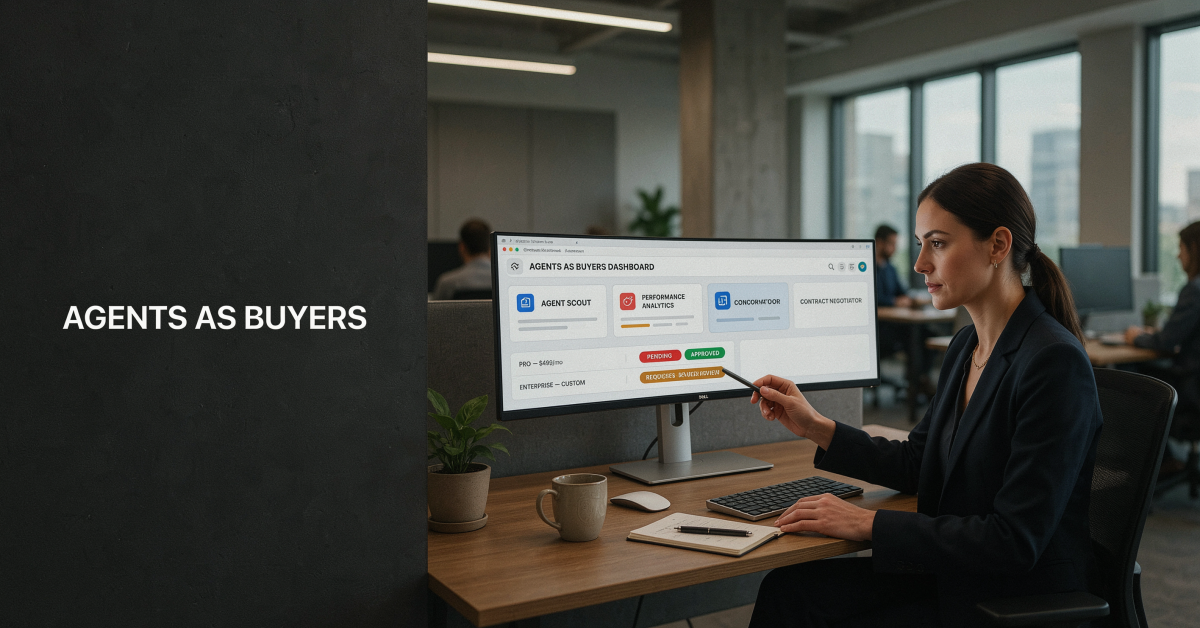
In a conventional software sale, a human evaluates a tool, negotiates terms, and authorises a purchase. Product-led growth compressed that cycle by letting users discover value before any sales conversation. Agent-led growth takes the next step: the agent itself identifies a capability gap, evaluates available options, and — within defined parameters — acquires what it needs to complete the task.
For that to work, software products need to be legible to agents in ways they currently are not. APIs alone aren't enough. Agents need to understand what a tool does, what it costs, what permissions it requires, and whether it's trustworthy — all programmatically, without a human intermediary walking them through a demo. Lightsage is positioning itself as the layer that makes software products discoverable and purchasable in that way.
The commercial mechanics are still nascent. But the infrastructural question underneath them is live: if an autonomous agent is going to make procurement decisions, what governs those decisions?
The Governance Problem Hiding in Plain Sight
Any business running autonomous agents today should read this development as a prompt to examine its own agent architecture. Agents that can acquire new capabilities — even in a tightly scoped way — represent a meaningful expansion of what those agents can affect. That's not a reason to avoid the model; it's a reason to get the controls right before the model matures.
The relevant questions aren't hypothetical. If an agent deployed for appointment scheduling or patient intake could, in principle, call out to a third-party service to complete a task, who authorises that call? What spend limits apply? What happens if the acquired capability introduces a data-handling practice that conflicts with existing compliance requirements?
An agent that can buy its own tools is more capable — and requires more deliberate constraints.
These aren't objections to agent-led growth as a concept. They're the design questions that responsible deployment demands. Containing the blast radius of an agent's actions has always been a core principle of sound agent architecture — and the ability to acquire new tools is simply a new surface area that the same principle must cover.
What This Signals for Businesses Deploying Agents Now
The Lightsage funding round is early-stage, and agent-led procurement at scale is still a few cycles away from mainstream deployment. But the investment signals something important about the direction of travel: the agentic ecosystem is being built with agents as first-class economic actors, not just execution engines.
That framing should inform how businesses think about the agents they deploy today. An agent designed purely as a task-runner — narrowly scoped, tightly monitored, with no external reach — is a very different thing from an agent designed as a participant in a broader software ecosystem. Both are legitimate design choices. The mistake is treating them as equivalent without intending to.
The infrastructure being built around agent-to-agent commerce, agent identity, and agent credentialing will eventually reach every organisation running autonomous systems. Understanding its shape now — before it arrives at scale — is what separates reactive deployment from deliberate strategy.
Agents that can buy are more useful. They're also more consequential. Both things are true at the same time.
Further Reading: siliconangle.com
Ready to Put Agentic AI to Work?
See how autonomous AI agents can handle booking, intake, and follow-up for your business.