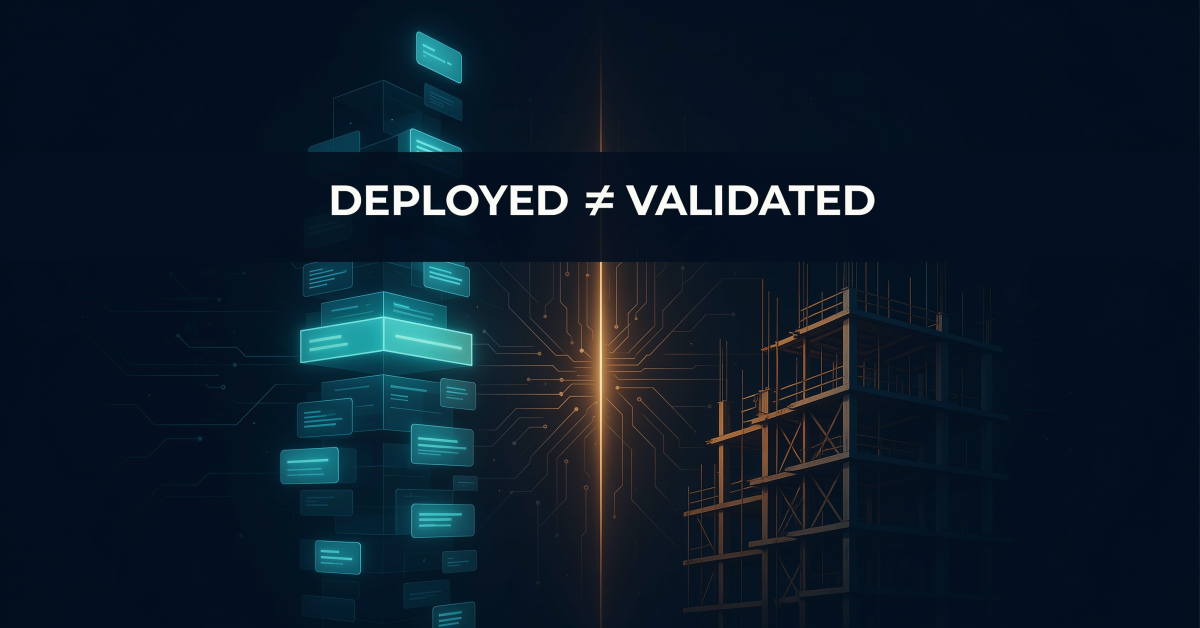
Deployed Doesn't Mean Safe.
Most health systems are running third-party AI tools they cannot properly test. Adoption without validation is a governance gap waiting to cause harm.
A new report has surfaced a striking asymmetry in healthcare AI adoption: more than 90% of health systems have deployed third-party AI tools, yet fewer than half have the infrastructure to properly test and validate those tools before they become embedded in patient care workflows. The adoption curve is steep. The governance curve is not keeping pace.
That gap deserves careful attention — not because AI in clinical settings is inherently unsafe, but because deployment without validation creates conditions where problems become visible only after harm has already occurred.
Why Validation Lags Behind Deployment
The pressure to adopt AI in healthcare is real and understandable. Staffing shortfalls, administrative burden, and rising patient volumes push health systems toward tools that promise efficiency. Vendor timelines move quickly. Procurement decisions follow urgency rather than readiness. The result is that AI systems go live before the organisation has built the capacity to ask hard questions about how those systems behave — under normal conditions and under edge cases that only emerge at scale.
Validation is not a one-time event. A tool that performs acceptably in a pilot cohort may behave differently when exposed to the full diversity of a health system's patient population, EHR configuration, or clinical workflow. Without ongoing monitoring infrastructure, drift goes undetected. Errors accumulate. And because AI outputs often arrive embedded in a broader clinical process, attribution becomes difficult — it is not always obvious that an AI recommendation was the upstream cause of a downstream problem.
Deployment without validation doesn't eliminate risk. It just delays when it becomes visible.
The Infrastructure Gap Is a Leadership Problem
It would be easy to frame this as a technology problem — health systems simply need better testing tools. But the infrastructure gap described in this report is at its core a leadership and governance problem. Organisations that lack validation capacity have usually not established who is responsible for AI oversight, what the threshold for acceptable performance looks like, or what triggers a review or rollback. Those are not technical questions. They are organisational ones.
The same dynamic appears whenever autonomous systems are introduced into high-stakes environments without corresponding accountability structures. A vendor's internal benchmarks are not a substitute for an organisation's own validation against its own data, its own patient population, and its own definition of acceptable risk. Health systems that have not built that capacity are, in effect, outsourcing their clinical risk assessment to the vendor — which has an obvious conflict of interest.
This is consistent with what sound agent architecture requires more broadly: layered oversight, not a single point of trust. No autonomous system — however well-designed — should operate without independent validation at the point of deployment and ongoing monitoring thereafter.
What Responsible Deployment Actually Requires
The report's findings point toward a necessary reframing of what AI readiness means in healthcare. Readiness is not the ability to sign a vendor contract and go live. It is the ability to answer a specific set of questions before go-live: How was this tool validated, and on what population? What are its known failure modes? Who monitors its performance after deployment? What is the escalation path when it produces an unexpected output? Who has authority to pause or remove it?
Organisations that cannot answer those questions are not ready to deploy — regardless of what the vendor's documentation says.
For any business deploying autonomous agents into consequential workflows, the lesson is structural: governance infrastructure is not a post-launch consideration. It is a prerequisite. The cost of building it before deployment is small compared to the cost of discovering its absence after something goes wrong. Meaningful human oversight does not have to slow operations — but it does have to exist before the first agent goes live, not as an afterthought once deployment is already embedded.
Further Reading: medcitynews.com
Ready to Put Agentic AI to Work?
See how autonomous AI agents can handle booking, intake, and follow-up for your business.