You handed the keys to an agent. Did you check the brakes first?
As autonomous agents take on mission-critical work, governance can't be an afterthought bolted on after deployment.
There is a specific moment in the maturation of any technology when the experimental budget stops being the right budget. Autonomous agents have reached that moment. They are no longer running in sandboxes or producing demos for executive briefings — they are handling booking flows, processing intake data, qualifying leads, and making consequential decisions in live production environments. And the governance infrastructure meant to oversee them, in most enterprises, has not kept pace.
A Workforce Without a File
When a human employee joins an organisation, a file opens. There is a record of their credentials, their access rights, their actions over time, and a chain of accountability that runs from their desk to their manager and ultimately to legal and compliance. That file is the foundation on which trust is extended and, when necessary, revoked.
Autonomous agents have none of this by default. They hold no badge number. They draw no paycheck. They carry no moral compass, and — critically — they leave no auditable track record unless one is deliberately engineered into their deployment. Enterprises that spent decades refining controls for human workers are now managing a second workforce that arrived without any of the bureaucratic scaffolding those controls depend on.
That is not a failure of the technology. It is a failure of implementation planning. The agents themselves are not rogue in the cinematic sense — they do not develop intentions. They are rogue in the infrastructural sense: operating outside the control boundaries the organisation thought it had established.
Agents don't go rogue because they want to. They go rogue because no one defined the boundary.
Governance as Foundation, Not Feature
The instinct in fast-moving deployments is to treat governance as a layer applied after the fact — a compliance checkbox added once the agent is already producing value. That instinct is understandable, and it is also the root cause of most of the failure modes now surfacing in enterprise AI.
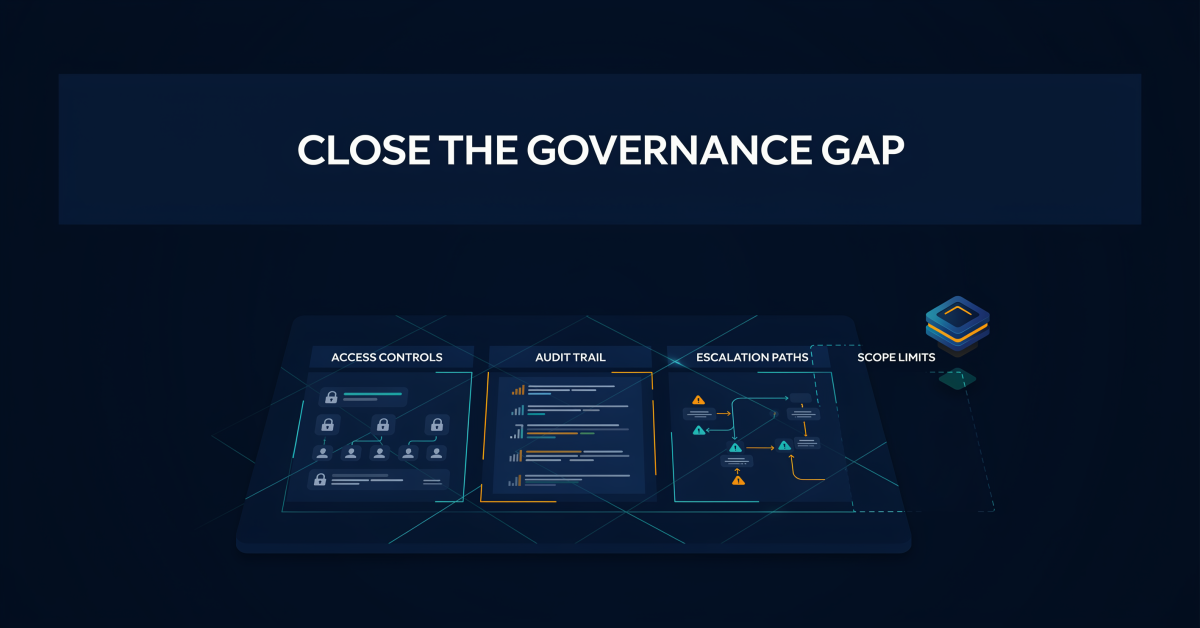
Governance that lives at the foundation looks different from governance bolted on top. It means defining the agent's scope of action before it touches a live system, not after the first incident. It means building audit trails into the agent's architecture, so every decision the system makes can be reconstructed, reviewed, and if necessary, overturned. It means treating access controls for agents with at least the same rigour applied to privileged human users — and arguably more, because an agent can act at a speed and scale no human employee can match.
The argument is sometimes made that tighter governance slows deployment and erodes the productivity gains that justify the investment. The evidence from production environments does not support this. As explored in the context of human oversight and agent throughput, well-designed governance structures do not impede autonomous agents — they create the conditions under which agents can be trusted with higher-stakes work over time. The ceiling on what an agent can be authorised to do is set by how well its behaviour can be verified.
What the Governance Reckoning Actually Requires
Describing the problem is easier than solving it, but the solution is not as exotic as the coverage sometimes implies. It does not require waiting for a regulatory framework to crystallise or for a single platform to solve identity management for agents industry-wide. It requires making deliberate choices at the point of deployment.
Three disciplines tend to separate deployments that scale safely from those that generate incidents. The first is scope definition: every agent should have a clearly documented set of actions it is authorised to take, and that set should be the minimum necessary to accomplish the task. The second is observability: if the agent's decision logic cannot be inspected after the fact, it should not be trusted with consequential decisions in the first place. The third is escalation design — scoped agents with governed autonomy outperform fully autonomous ones precisely because they are built with defined handoff points where a human can intervene before irreversible actions occur.
The governance reckoning that enterprises are now navigating is not a crisis to be survived. It is an architecture problem to be solved — and the businesses that treat it as such, early, will find themselves with a meaningful competitive advantage as agent deployment deepens. Those that defer it will eventually discover that the second workforce they stood up has been making decisions they cannot explain, in systems they thought they controlled.
Further Reading: siliconangle.com
Ready to Put Agentic AI to Work?
See how autonomous AI agents can handle booking, intake, and follow-up for your business.