Oversight Shouldn't Be the Bottleneck.
Human review doesn't have to mean human delay. The design question is where attention goes — not whether it's there.
There's a version of human oversight that sounds responsible and performs like a bottleneck. It routes every agent output through a human reviewer, creates approval queues that back up under volume, and eventually produces the worst outcome of all: rubber-stamp approvals from reviewers who have learned that nothing flagged is ever actually wrong.
That model doesn't make agentic systems safer. It makes them slower, and it trains the human layer to disengage.
The Oversight Paradox
The instinct to review everything is understandable. When an organisation first deploys autonomous agents, uncertainty about failure modes is high and trust in the system is low. Universal review feels like a control mechanism. In practice, it's a scaling ceiling.
The volume problem arrives quickly. An agent handling appointment intake, follow-up sequencing, or document triage can process hundreds of interactions in the time a human reviews ten. If every action requires sign-off, the agent's throughput is capped by the reviewer's availability — and the economics that justified deployment evaporate.
Worse, high-volume queues change reviewer behaviour. When everything is flagged, nothing feels urgent. Reviewers begin approving at pace rather than with care, and the human-in-the-loop becomes a formality rather than a control. The oversight exists on paper; the risk doesn't go away.
When everything is flagged, nothing feels urgent. The human layer becomes a formality — not a control.
Routing Attention, Not Every Action
The better design is not less oversight — it's more precise oversight. The goal is routing human attention to the decisions that actually warrant it, and letting the agent proceed autonomously on everything else.
This requires the system to assess its own confidence before acting. An agent that knows when to escalate is more valuable than one that either never escalates or always does. Confidence scoring, uncertainty thresholds, and explicit escalation rules — built into the agent's logic at design time — are what make that possible.
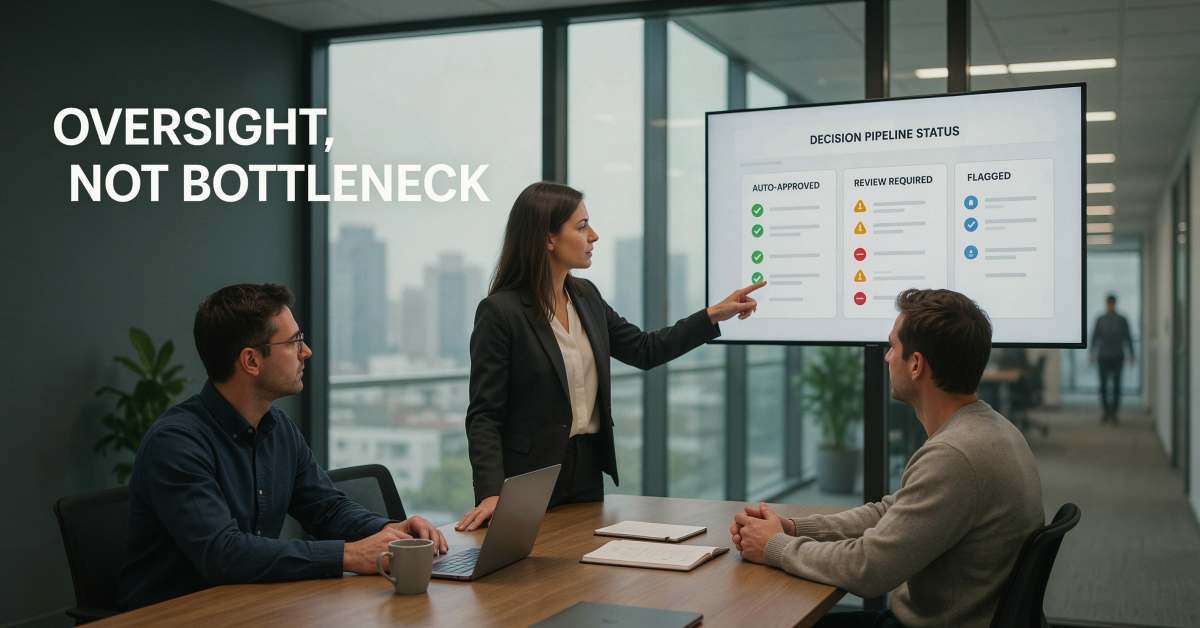
The practical categories look something like this. Actions the agent performs routinely with high confidence and low consequence proceed without review. Actions that fall below a confidence threshold, involve an unusual data pattern, or carry material consequence are held for human attention. Actions that are genuinely novel or outside the agent's defined scope are escalated immediately — not queued.
This is the architecture described in well-governed agentic deployments: a tiered model where the volume of fully autonomous actions is high, the volume of reviewed actions is low, and the reviewed actions are the ones that actually matter. The human reviewer's cognitive load is manageable precisely because the signal-to-noise ratio of what reaches them is high.
It's also worth noting that this structure is what makes agents auditable over time. When escalation logs reflect genuine uncertainty or edge cases, they become a meaningful dataset — something that can improve the confidence model, sharpen scope definitions, and reduce future escalation rates. A well-designed oversight layer learns. A rubber-stamp queue doesn't.
Building Oversight Into Scope, Not Just Workflow
One underappreciated lever is the initial scoping of the agent's remit. An agent deployed with a tightly defined task boundary will encounter fewer genuinely ambiguous situations than one given broad, open-ended instructions. Scoped agents don't just perform better — they escalate more cleanly, because the boundary between what they handle autonomously and what they pass upward is legible to the system and to the human reviewer.
This is a governance design decision, not a technical afterthought. Organisations that define escalation criteria at deployment time — rather than discovering them reactively when something goes wrong — tend to maintain meaningful oversight as volume scales. Those that treat human-in-the-loop as a checkbox rarely do.
The argument isn't that agents should operate with less human involvement. It's that human involvement should be engineered to remain meaningful as throughput grows. A reviewer who sees ten genuinely uncertain decisions per day is performing a real governance function. A reviewer approving three hundred routine actions per hour is not — regardless of how the process looks on an org chart.
For any business running autonomous agents at scale, the design question worth asking is not 'how much do we review?' but 'are the things we review actually the things that warrant review?' The answer to that question determines whether oversight is a control or a costume.
Further Reading: towardsdatascience.com
Ready to Put Agentic AI to Work?
See how autonomous AI agents can handle booking, intake, and follow-up for your business.