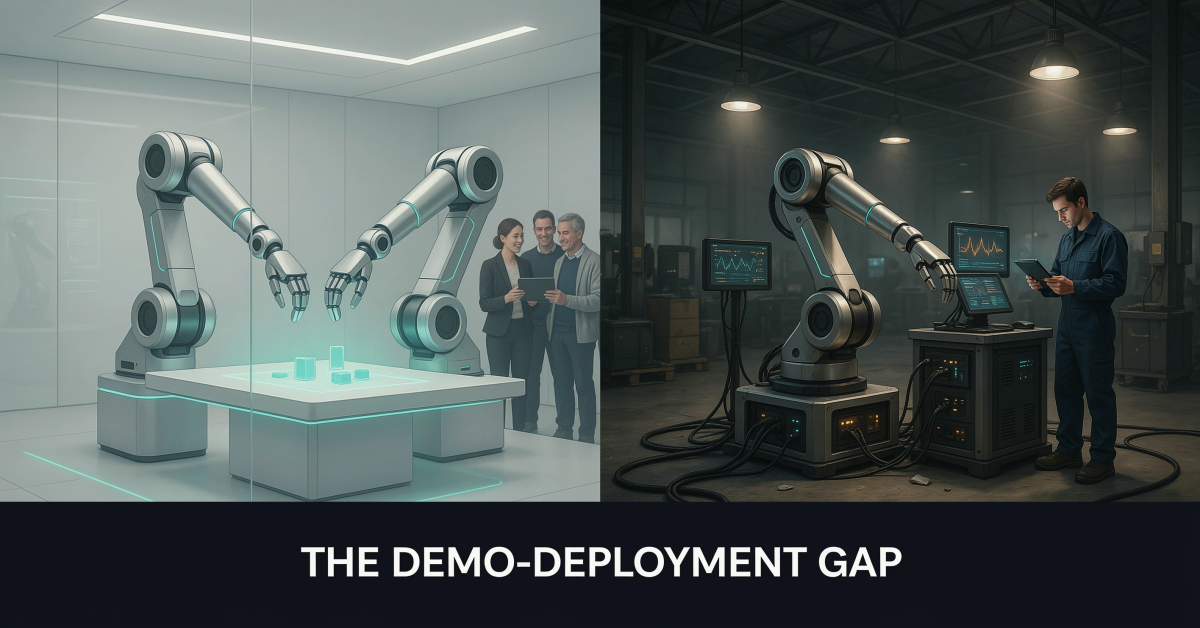
The Demo Works. The Deployment Doesn't. Here's Why.
Physical AI promises machines that perceive and act in the real world. But the gap between a controlled demo and reliable production is wider than it looks.
There is a familiar pattern in enterprise AI adoption: a system performs impressively in a controlled environment, leadership approves a rollout, and then reality intervenes. Latency spikes. Edge cases multiply. Data pipelines that worked in testing buckle under production load. For conventional software AI — models that generate text, classify images, or surface recommendations — these challenges are well understood, if not always well managed. For physical AI, they are an order of magnitude harder.
Physical AI refers to systems that do not merely process information but perceive the real world, reason about it, and take action within it. Autonomous robots, sensor-driven industrial systems, real-time logistics agents — these are the early expressions of a category that AWS and others are now investing heavily to bring to scale. The potential is significant. The operational complexity is equally so.
What Makes Physical AI Deployment Genuinely Different
Digital AI agents operate in a world where a failed inference can be retried, a slow response can be queued, and a bad output can be flagged and corrected before it causes harm. Physical AI does not have that luxury. A robot arm that misreads a sensor input does not get a do-over. A warehouse routing system that hesitates for 200 milliseconds too long creates a real-world collision risk. The margin for error is compressed in ways that cloud-native software engineers rarely encounter.
Three challenges stand out as particularly consequential. First, latency: physical systems often require inference at the edge, where connectivity is unreliable and the round-trip to a cloud model is too slow. The infrastructure required to run capable models locally — with the power, cooling, and management overhead that entails — is still maturing. Second, data: physical AI depends on high-fidelity sensor data that is continuous, contextual, and often messy. Calibration drift, environmental variation, and sensor failure are not theoretical edge cases; they are routine. Third, lifecycle management: a software model can be updated silently overnight. A deployed physical system may require coordinated firmware updates, safety validation, and in some cases physical access to hardware. The operational cadence is closer to manufacturing than to software development.
The Infrastructure Gap AWS Is Trying to Close
AWS's recent moves in this space reflect an acknowledgment that the infrastructure layer for physical AI is not yet fit for purpose at scale. The tools that exist for training and evaluating models in simulation do not automatically translate into reliable production pipelines for systems operating in the physical world. Bridging that gap requires investment across simulation environments, edge compute, real-time data orchestration, and deployment tooling — none of which is trivial, and all of which must work together.
This is not a problem unique to robotics or industrial automation. Any organisation deploying AI agents that interact with time-sensitive, real-world processes — whether that is a voice agent handling a live phone call, a booking system responding to a customer in real time, or an intake workflow that must act on information the moment it is received — faces a version of the same challenge. The physics may differ, but the underlying tension between demo performance and deployment reliability is structurally the same.
The gap between a working demo and a reliable deployment is where most AI ambitions quietly stall.
What This Means for Businesses Deploying Autonomous Agents
The physical AI conversation is a useful mirror for anyone evaluating autonomous agent deployments more broadly. The instinct to move quickly from proof of concept to production is understandable — demos are compelling, and competitive pressure is real. But the organisations that deploy reliably tend to be the ones that treat the operational layer with the same rigour as the model layer.
That means asking hard questions before rollout: Where does the agent's data come from, and how is its quality monitored over time? What happens when the agent encounters a scenario it was not trained on? Who owns the response when the system behaves unexpectedly? These are not abstract governance questions — they are the practical preconditions for a deployment that holds up beyond the first few weeks.
As explored in the context of scoped versus fully autonomous agents, the most durable deployments tend to be those where autonomy is granted incrementally, with clear boundaries and oversight mechanisms in place from the start. Physical AI makes that principle viscerally obvious — the consequences of an unscoped agent in the physical world are immediate and tangible. But the principle applies whether the agent is moving a robot arm or answering an inbound call.
The demo-to-deployment gap is real, it is well documented, and it is not closed by better models alone. It is closed by better operational design — and that discipline is available to any organisation willing to apply it.
Further Reading: siliconangle.com
Ready to Put Agentic AI to Work?
See how autonomous AI agents can handle booking, intake, and follow-up for your business.