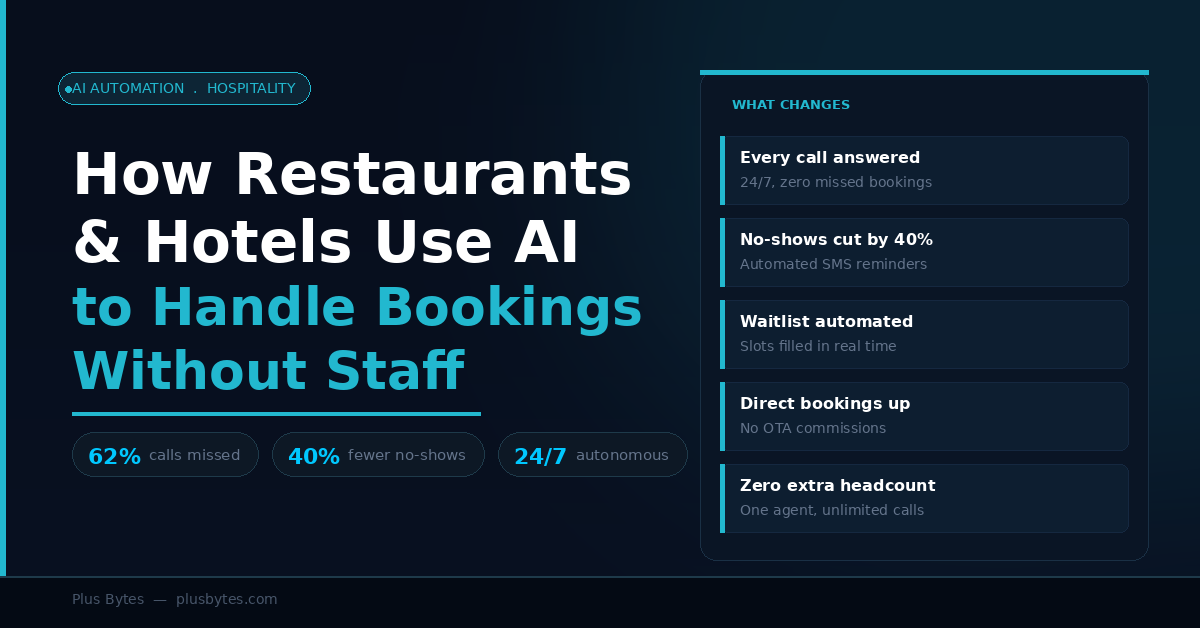
How Restaurants and Hotels Are Using AI to Handle Bookings Without Staff
Your host stand is overwhelmed, your phone rings unanswered at 10 pm, and your reservation system sits idle all weekend. Here's how autonomous AI agents are solving all three — simultaneously.
Picture a busy Friday evening at a restaurant in Austin or a boutique hotel in Nashville. The phone is ringing — a guest wants to book a table for Saturday night. The host is juggling three tables, the front desk is checking someone in, and the call goes to voicemail. By morning, that guest has booked somewhere else.
This plays out thousands of times a day across the US hospitality sector. And it isn't just frustrating — it's measurable lost revenue. The good news is that AI booking agents are eliminating this problem entirely, for restaurants and hotels of every size.
The Staffing Problem Nobody Wants to Admit
Hospitality runs on people. But the economics of maintaining a fully staffed front desk — 7 days a week, evenings included — have never been harder. The National Restaurant Association reports that 62% of operators say labor costs are their biggest challenge. Turnover in hospitality consistently runs above 70% annually. And guests increasingly expect instant responses at times when your team simply isn't available.
The traditional answer has been: hire more staff, add a reservations coordinator, or route bookings through third-party platforms like OpenTable or Yelp. Each of these comes with trade-offs. More staff means more cost. Coordinators still sleep. And third-party platforms charge per-cover fees that quietly erode your margins on every booking they generate.
"An AI booking agent doesn't replace your hospitality team. It handles the calls they can't — and captures the revenue that would otherwise go to voicemail."
AI booking agents offer a fundamentally different model: a system that works autonomously around the clock, handles unlimited simultaneous calls, integrates directly with your existing reservation or property management system, and costs a fraction of a full-time hire.
What an AI Booking Agent Actually Does
This isn't a widget that asks guests to fill out a web form. A modern AI booking agent handles voice calls — it answers your business phone line, speaks naturally, understands what the caller wants, checks real-time availability, confirms the reservation, and sends an SMS or email confirmation. All without a human in the loop.
Here's what that looks like for a restaurant:
Inbound Reservation Calls
Answers every call within 2 rings. Collects date, time, party size, name, and special requests. Confirms against live table availability in your reservation system.
Automated Reminders
Sends an SMS reminder 24 hours and 2 hours before the reservation, reducing no-shows by up to 40% without your staff lifting a finger.
Cancellations & Rescheduling
Handles modification requests autonomously. Frees up the slot, updates the reservation system, and confirms the change to the guest instantly.
Waitlist Management
When fully booked, adds callers to a waitlist and automatically notifies them the moment a slot opens — capturing revenue that would otherwise be lost.
For hotels, the capability extends further:
Room Enquiries & Direct Booking
Answers questions about room types, rates, and availability. Takes direct reservations — bypassing OTA commissions from Booking.com or Expedia entirely.
Upsell During Booking
Offers room upgrades, breakfast packages, or late checkout naturally during the booking conversation — increasing average booking value without any sales pressure.
Pre-Arrival Messaging
Sends check-in instructions, parking details, and early check-in options before arrival — reducing front desk queues and improving the guest experience from day one.
Post-Stay Follow-Up
Sends a review request or loyalty offer after checkout — automatically, at the right time, without your team needing to remember to do it.
Before vs. After: A Typical Week in Hospitality
Without AI
- Missed calls after 9 pm every night
- No coverage on weekends and holidays
- No-show rate of 15–20% with no systematic reminders
- Waitlists managed on paper or not at all
- Per-cover fees to OpenTable on every booking
- OTA commissions eating 15–25% of hotel revenue
With AI Booking Agent
- Every call answered in 2 rings, 24/7
- Bookings handled autonomously on weekends and holidays
- No-show rate drops below 8% with automated SMS reminders
- Waitlist managed automatically, slots filled in real time
- More direct bookings, fewer third-party fees
- Direct hotel bookings increase, OTA dependency decreases
The Revenue Case Is Straightforward
A mid-sized restaurant in a major US city that misses 40 calls a week — each representing a table of 4 at a $60 average check — is walking away from roughly $9,600 in potential revenue every month. That's over $115,000 a year going to voicemail.
The Maths Are Simple
40 missed calls per week × $240 average table spend = $9,600 in lost revenue every month. An AI booking agent typically costs less than a single part-time hire — and works every hour of every day without a break, sick day, or two weeks' notice.
For hotels, the numbers are even more compelling. Every direct booking that bypasses Expedia or Booking.com saves 15–25% in commission. An AI agent that converts even a fraction of OTA-destined enquiries to direct bookings pays for itself many times over.
The Peak-Hour Problem — and Its Solution
Hospitality has a challenge that most industries don't face: demand is intensely concentrated. A restaurant receives the majority of its reservation calls in a two-hour window on Friday and Saturday evenings. A hotel gets a spike of enquiries during holiday weekends and conference season. In these windows, no human team can handle every simultaneous call.
An AI booking agent has no such limitation. It handles unlimited simultaneous calls with consistent quality — no caller hears a busy signal, no message goes to voicemail, and no booking is lost to a long hold time. This alone can represent a significant revenue uplift during your busiest periods.
Integration: How It Connects to Your Existing Systems
A common concern from restaurant and hotel operators is complexity: "Does this mean replacing our current system?" The answer is no. A well-built AI booking agent integrates with what you already use — whether that's OpenTable, Toast, Resy, Cloudbeds, or Opera PMS — and adds the autonomous voice layer on top.
The integration layer typically covers:
- Live availability sync — the agent checks real-time availability before confirming any booking, so you never get double-booked
- CRM update — guest details are logged automatically after every call, building your first-party database over time
- SMS / email confirmations — sent instantly after booking, reminder, or modification
- Escalation rules — VIP guests, complaints, or unusual requests are routed to a human with full call context included
You don't need to change how your team works. The agent fills the gaps — the off-hours, the simultaneous calls, the follow-ups — that your team physically can't cover.
What to Look for in an AI Booking Agent for Hospitality
Not all AI booking solutions are equal. Generic tools built for generic businesses will struggle with the nuances of hospitality — handling dietary restrictions, managing large group inquiries, navigating cancellation policies, or understanding the difference between a standard reservation and a private dining request.
When evaluating providers, look for:
- Custom training on your property — the agent should know your menu, your room types, your policies, and your brand voice specifically
- Real-time system integration — not a batched sync, but live availability checks at the moment of the call
- Hallucination monitoring — regular audits to ensure the agent never makes up information about your business
- Ongoing knowledge base updates — prices, hours, and policies change; your provider should update the agent continuously
- Measurable ROI reporting — monthly reports showing calls handled, bookings captured, no-shows prevented, and revenue recovered
The Bottom Line
The hospitality businesses that will lead the next decade won't necessarily have the largest teams. They'll have the most responsive ones. An AI booking agent is the infrastructure that lets a 12-person restaurant operate like one with a 24/7 reservations desk — without the payroll to match.
The technology is production-ready. The economics are clear. The only question is whether you move before your competitors do.
Plus Bytes deploys custom AI booking agents for restaurants, hotels, and hospitality businesses. If you want to see exactly how an AI agent would handle your booking calls, book a free 30-minute demo — no pitch, just a live walkthrough.
Ready to Stop Missing Bookings?
Book a free 30-minute demo. We'll show you exactly how an AI agent handles your restaurant or hotel calls — live, in real time.