Most businesses think they've adopted AI. They haven't.
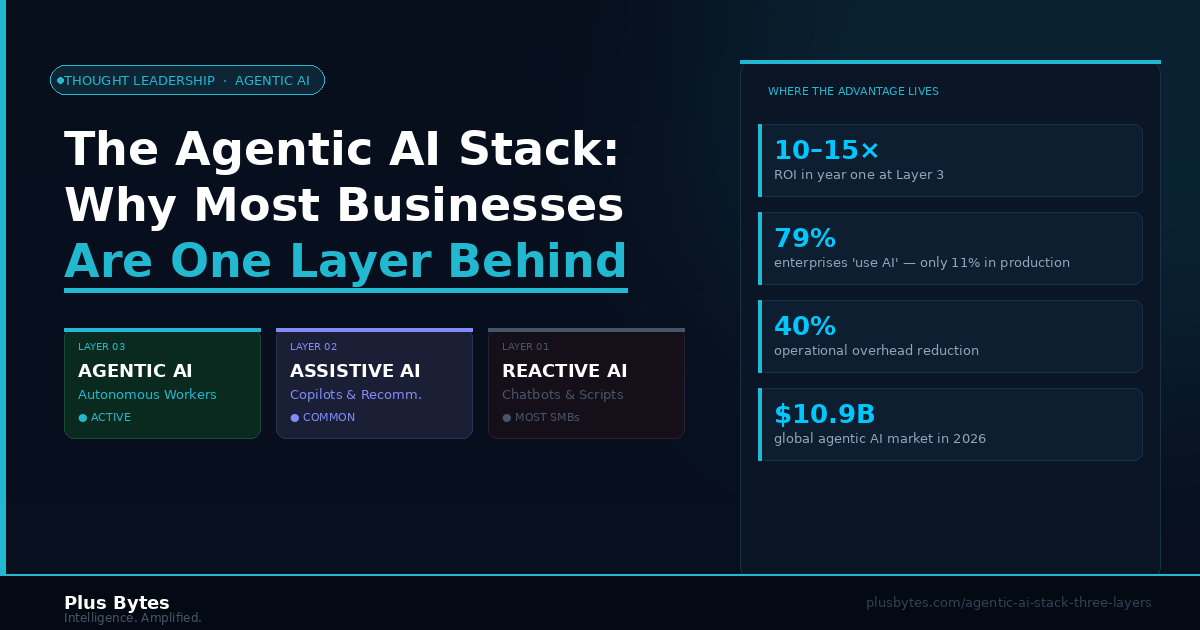
There are three distinct layers of AI capability. The majority of businesses are operating at layer one — and calling it a strategy. Here's what the stack actually looks like, and where the real competitive advantage lives.
Ask a business owner in 2026 whether they're using AI, and the answer is almost always yes. They have a chatbot on their website. Their CRM has an AI summary feature. Someone on the team uses ChatGPT to write emails faster.
And technically, all of that is AI. But none of it is what's actually reshaping competitive advantage right now. The businesses pulling ahead aren't using AI as a productivity accessory. They're deploying it as an autonomous workforce — systems that don't wait to be prompted, don't stop at 6 pm, and don't need a human to make the next decision.
Understanding the difference requires understanding the stack.
The Three Layers of AI Capability
Not all AI is created equal. There is a clear hierarchy of capability — and where your business sits on that hierarchy determines how much competitive leverage you're actually getting from your AI investment.
Why Most Businesses Are Stuck at Layer One
The confusion is understandable. The marketing around AI tools has been deliberately ambiguous — every product calls itself "AI-powered," from a spell-checker to a fully autonomous agent. When a CRM adds an AI summary button, it gets announced as an AI transformation. When a website gets a chatbot, the business owner reasonably believes they've adopted AI.
But reactive AI — layer one — has a hard ceiling. It responds. It doesn't act. It can tell a website visitor what your opening hours are, but it can't book them an appointment, update your calendar, send a confirmation, and follow up 24 hours later. That entire sequence requires autonomy, system access, and decision-making capability that chatbots simply don't have.
"The gap between layer one and layer three isn't a software upgrade. It's an architectural shift — from AI as a tool you use, to AI as a worker you deploy."
The data makes this gap visible: 79% of enterprises report having adopted AI agents in some form, yet only 11% run them in production. The remaining 68% are in a no-man's-land — they've invested in AI, they're paying for AI subscriptions, but they're not getting the compounding operational returns that layer three delivers.
What Layer Three Actually Looks Like in Practice
Agentic AI isn't a product you buy off the shelf. It's a system you architect around your specific business workflows. The agent needs to know your business — your calendar rules, your pricing, your brand voice, your escalation paths. It needs to connect to your existing systems. And it needs guardrails that prevent it from hallucinating or acting outside its defined scope.
When it's built correctly, here's what changes:
Time Reclaimed
Repetitive, high-volume tasks — answering calls, booking appointments, sending reminders — are handled autonomously. Your team focuses on work that requires human judgment.
Revenue Leakage Stopped
Every missed call after hours, every unanswered inquiry over the weekend, every lead that never got a follow-up — an agentic system captures all of it without adding headcount.
Systems That Talk to Each Other
The agent doesn't just respond — it acts across your stack. A booked appointment updates your calendar, triggers a CRM record, queues a reminder, and logs the interaction. One workflow, zero manual steps.
Consistent, Governed Behaviour
Unlike human teams, an agentic system behaves identically every time. No off days, no forgotten follow-ups, no policy violations. Guardrails ensure it never acts outside its defined scope.
The Window Is Narrowing
Gartner forecasts that 40% of enterprise applications will embed task-specific AI agents by end of 2026, up from less than 5% in 2024. That's not a gradual shift — that's a compression of eight years of normal technology adoption into eighteen months.
The businesses moving to layer three now are doing so while their competitors are still debating which chatbot to install. That window doesn't stay open indefinitely. When agentic AI becomes table stakes — when every competitor in your market has a 24/7 booking agent, automated follow-up, and AI-driven lead qualification — the advantage shifts to whoever built the better system, not whoever adopted first.
The Competitive Reality
96% of enterprises are expanding their use of AI agents, and 83% of executives view agentic AI investment as essential to staying competitive. The businesses that move now set the benchmark. The ones that wait inherit a gap they'll spend years trying to close.
Why Implementation Is the Hard Part
The biggest misconception about agentic AI is that it's a deployment problem — that you sign up for a platform and turn it on. In reality, the technology is the easy part. The hard part is everything that makes it work for your specific business:
- Workflow mapping — understanding exactly which tasks the agent should own, which it should support, and which require human judgment
- System integration — connecting the agent to your calendar, CRM, phone system, and messaging platforms so it can actually act, not just respond
- Knowledge grounding — training the agent on your specific business: your prices, your policies, your brand voice, your escalation rules
- Hallucination governance — building guardrails and audit processes to ensure the agent never invents information or acts outside its scope
- Continuous optimisation — monitoring performance, updating the knowledge base as your business changes, and upgrading the underlying model when better options become available
This is why off-the-shelf AI tools rarely deliver on the promise. A generic booking bot isn't trained on your business. It doesn't know your cancellation policy, your VIP client rules, or the specific way your team handles escalations. It's layer one dressed up as layer three.
Where Plus Bytes Fits
Plus Bytes exists specifically to close the gap between where most businesses are — layer one — and where the competitive advantage actually lives — layer three. We don't sell software licences. We architect, deploy, and manage autonomous AI systems built around your specific workflows, your existing tech stack, and your business rules.
Every deployment goes through three phases: a blueprint stage where we map your workflows and identify exactly where an agent creates the most value; a pilot stage where the agent goes live with human oversight and weekly performance audits; and a scale stage where we hand over a fully optimised system with monthly ROI reporting showing exactly what it saved and earned.
The result isn't AI you use. It's AI that works — autonomously, consistently, and measurably — while your team focuses on the things only humans can do.
If you want to understand exactly where your business sits on the agentic AI stack — and what it would take to move to layer three — book a free 30-minute discovery call. No pitch. Just a clear map of your current state and what's possible.
Which Layer Are You Operating At?
Book a free 30-minute discovery call. We'll map your current AI stack and show you exactly where layer three creates the most value for your business.