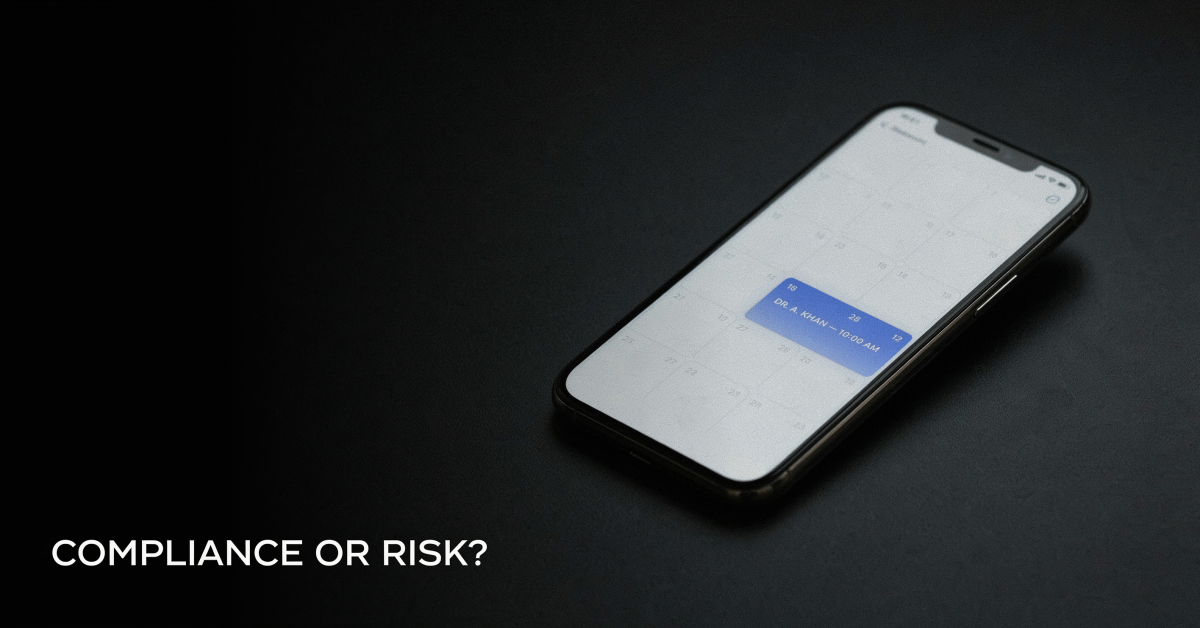
Your Phones Don't Stop at 5pm. Your AI Shouldn't Either.
A HIPAA-compliant AI answering service handles patient calls, booking, and intake — around the clock, without putting PHI at risk.
If a dental practice is searching for a HIPAA compliant AI answering service, the question behind the question is usually this: can automation actually handle patient calls without creating a compliance liability? The short answer is yes — but only when the system is built with the right architecture from the ground up, not retrofitted with a privacy policy as an afterthought.
What HIPAA Compliance Actually Requires from an AI Answering System
HIPAA compliance in this context is not a badge a vendor earns once and keeps forever. It's an ongoing operational posture. For an AI answering service handling dental patient calls, the minimum requirements include a signed Business Associate Agreement (BAA) with the vendor, end-to-end encryption of any data transmitted or stored, access controls that limit who and what can touch protected health information (PHI), and audit logging so there is a clear record of what the system did with patient data.
Many off-the-shelf AI tools — general-purpose chatbots, consumer voice assistants, low-cost answering services — were not designed with these requirements in mind. Plugging one into a dental front desk without a BAA in place is not a gray area. It is a direct exposure. The right question to ask any vendor is not 'are you HIPAA compliant?' but 'will you sign a BAA, and what does your data handling architecture look like at a technical level?'
What to Ask Before You Sign With Any AI Answering Vendor
Will you sign a BAA? Where is patient data stored, and for how long? Is call audio retained, and who can access it? What encryption standard is used in transit and at rest? How is the system audited if a complaint is filed? A vendor that hesitates on any of these is not a safe partner for a healthcare practice.
What It Costs — and How It Compares to a Human Receptionist
A full-time front-desk receptionist at a dental practice typically costs somewhere in the range of $35,000 to $50,000 per year in salary alone, before benefits, turnover, training, and the unavoidable gaps in coverage — lunch breaks, sick days, evenings, weekends. A purpose-built AI answering agent for a dental or aesthetics practice generally runs at a fraction of that, often in the range of a few hundred to low thousands of dollars per month depending on call volume, integrations, and scope of the workflow.
That comparison is directionally useful, but the more important framing is capacity. A human receptionist fields one call at a time. An AI system handles simultaneous inbound calls, books appointments directly into the practice management system, captures intake information, and routes urgent requests — all without hold times. For a busy single-location dental practice missing calls after hours or during peak periods, the revenue recovery from reduced missed appointments often offsets the cost quickly.
The cost of getting this wrong — a PHI breach, an OCR investigation, patient trust erosion — is harder to quantify but far more consequential. That's why governance and compliance architecture should come first in any evaluation, and cost second.
What a Well-Built System Actually Does at the Front Desk
A well-scoped HIPAA compliant AI answering service for a dental practice is not a simple call-screening bot. It handles inbound appointment requests, confirms and reschedules existing appointments, collects pre-visit intake information, routes after-hours calls with appropriate urgency logic, and hands off to a human staff member when the situation warrants it. The AI voice agent should sound natural enough that patients engage comfortably, but the compliance and data-handling layer underneath is what determines whether the practice is protected.
Integration matters significantly here. A system that captures patient information but cannot write it back into the practice's scheduling software — Dentrix, Eaglesoft, Open Dental, or similar — creates manual reconciliation work that eliminates much of the efficiency gain. The best implementations connect directly to existing systems, so the AI's actions are reflected in real time without staff having to re-enter data.
The compliance layer is not a feature. It's the foundation everything else runs on.
The Practical Takeaway for Practices Evaluating This Right Now
Any dental practice seriously evaluating an AI answering service should run three checks before going further with any vendor: confirm the BAA is available and specific, verify the data architecture handles PHI at rest and in transit with documented encryption, and request a clear explanation of what happens to call recordings and patient data after a call ends. If a vendor can answer all three clearly and in writing, the conversation is worth continuing. If the answers are vague or deferred, the risk profile is not acceptable for a healthcare environment regardless of the price point.
Purpose-built systems designed for dental and medical practices — rather than general-purpose AI tools adapted for healthcare — tend to have these structures in place from the start, because they were built for this regulatory environment rather than fitted to it after the fact.
Ready to Put Agentic AI to Work?
See how autonomous AI agents can handle booking, intake, and follow-up for your business.