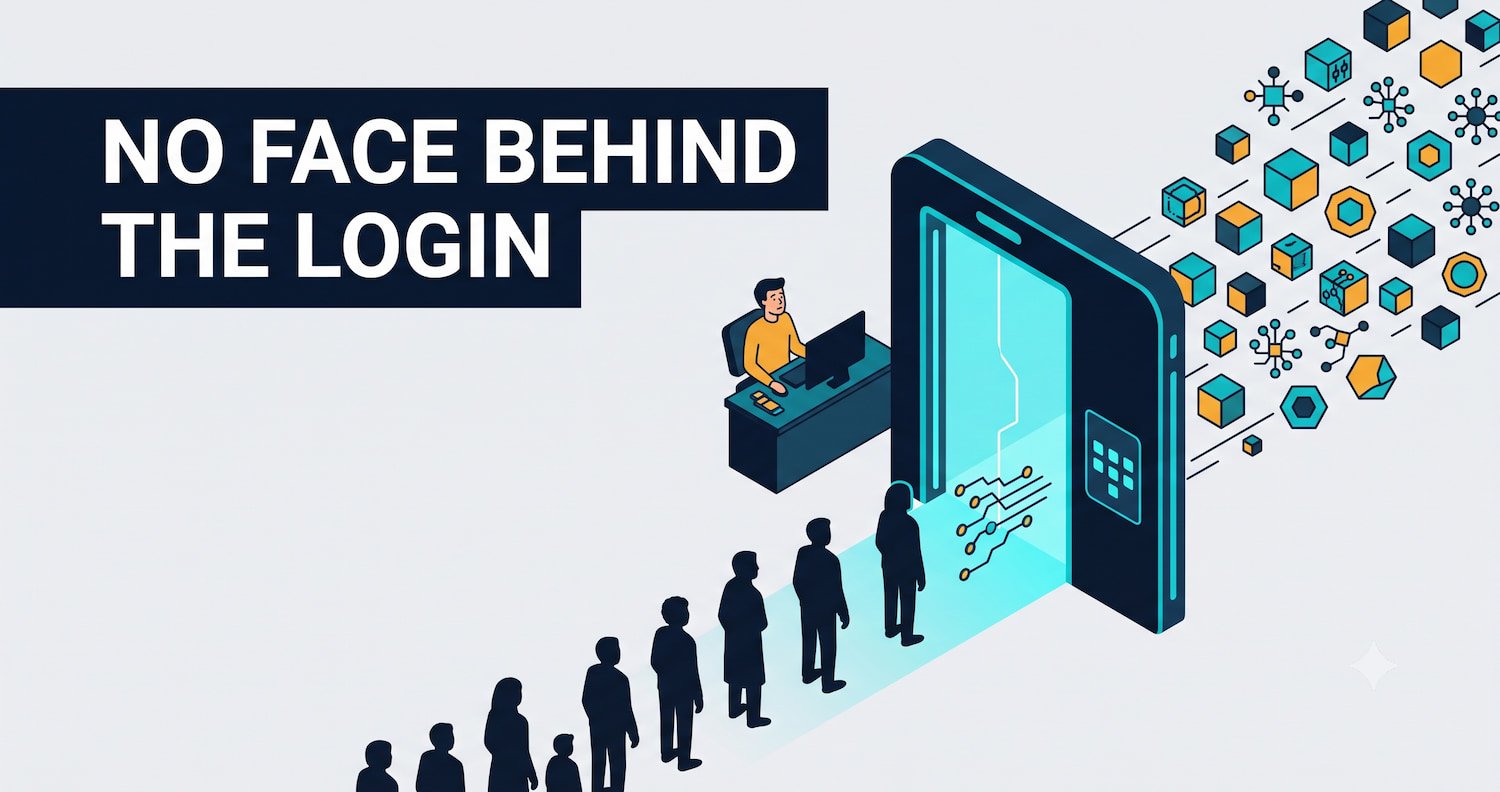
No Face Behind the Login. No Human at the Controls.
AI agents don't authenticate like people. The identity infrastructure built for humans was never designed to govern them.
Every enterprise identity system ever built assumed a human was on the other end. A username. A password. A face behind the credential. AI agents break that assumption at the root — and the security industry is only now beginning to reckon with the gap.
CrowdStrike's move to build a dedicated identity provider for AI agents, not humans, is one of the clearest signals yet that the infrastructure underpinning agentic deployments is being rebuilt from the ground up. The question for any organisation running autonomous agents isn't whether this shift matters — it's whether their current setup will survive it.
Why Human Identity Systems Fail Agents
Traditional identity and access management was designed around a simple premise: a person authenticates, and that authentication traces back to an accountable individual. Role-based permissions, multi-factor prompts, session timeouts — all of it presupposes a human making deliberate choices on the other side.
AI agents operate on entirely different terms. There is no single owner. There is no face behind the login. An agent may be invoked by another agent, run across multiple systems simultaneously, and take consequential actions in milliseconds — long before any human reviewer could intervene. Mapping that behaviour onto a credential system built for people doesn't produce governance. It produces the appearance of governance while leaving the actual risk unaddressed.
The problem compounds at scale. Enterprises that deploy dozens of agents today will likely run hundreds within two to three years. Human-centric identity infrastructure doesn't scale to that volume; it bends under the weight of it.
What Agent-Native Identity Actually Requires
An identity layer built for agents needs to answer questions that human IAM systems never had to ask. Which agent is acting? On whose behalf? What was it authorised to do — and by what chain of delegation did that authorisation arrive? What did it actually do, and can that be audited at the action level rather than just the session level?
These aren't incremental extensions of existing frameworks. They require a fundamentally different architecture — one that treats the agent itself as a first-class identity principal, assigns it scoped permissions tied to specific tasks rather than broad role categories, and logs its behaviour in a way that supports real accountability after the fact.
The agent is the principal now. Identity infrastructure needs to catch up to that reality.
Scoped, task-specific permissions aren't just a security preference — they're a governance requirement. An agent authorised to retrieve appointment data should not, by virtue of its credential, also be able to modify billing records. That kind of containment only exists if the identity layer was designed to enforce it at the agent level from the start. The case for scoped agents over broadly autonomous ones is precisely this: tighter authorisation boundaries produce more auditable, more defensible deployments.
The Governance Signal Underneath the Security Announcement
It would be easy to read CrowdStrike's move as a cybersecurity product launch and nothing more. But the more significant signal is what it reveals about organisational readiness. If a major security vendor is building agent identity infrastructure from scratch, it is acknowledging — publicly — that the existing stack was never adequate for agentic workloads.
That has direct implications for businesses already running autonomous agents. Deploying agents on top of human-centric identity systems isn't a temporary workaround; it's a structural vulnerability. And as agent populations grow and the actions they take become more consequential, the gap between what those systems can track and what actually happened in the environment widens.
The organisations that will navigate this well aren't those waiting for identity infrastructure to mature before deploying agents. They're the ones building governance discipline into every layer of their agentic stack now — starting with a clear answer to the question that every identity system ultimately has to answer: who, exactly, is acting here, and what were they permitted to do? When the answer to that question involves an autonomous agent rather than a person, the architecture required to answer it honestly is different in kind, not just in degree. Visibility at machine speed only matters if the identity layer underneath it can tell you whose actions you're actually watching.
Further Reading: siliconangle.com
Ready to Put Agentic AI to Work?
See how autonomous AI agents can handle booking, intake, and follow-up for your business.