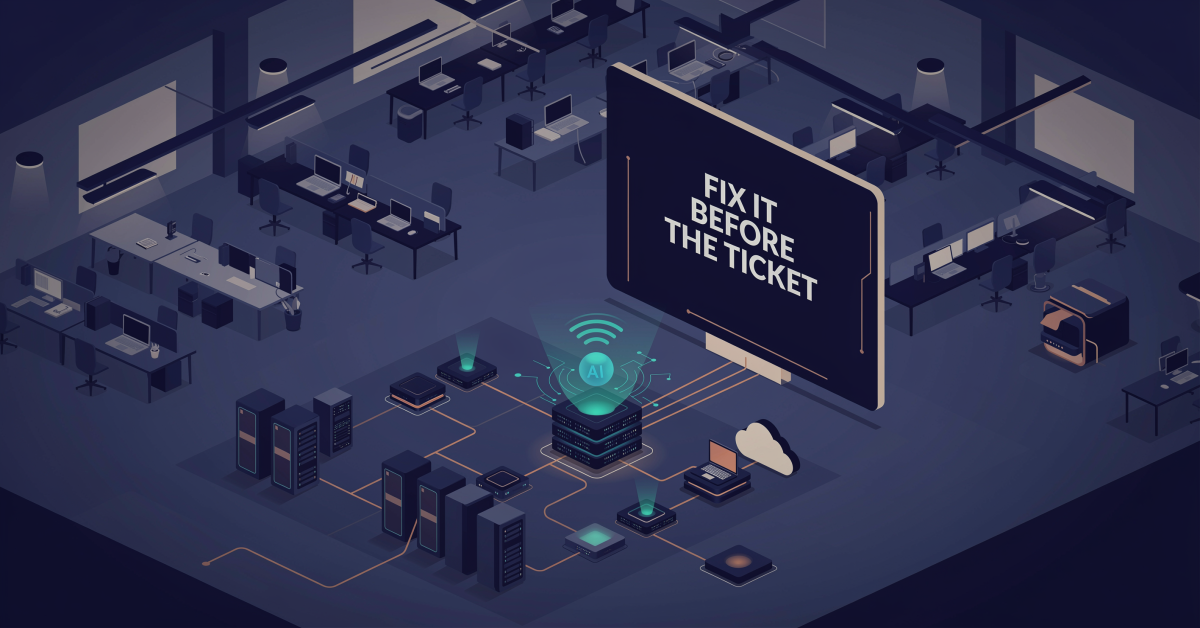
The best help desk ticket is the one never filed.
Serval's Catalyst doesn't wait for employees to report problems — it finds them, drafts the fix, and queues it for human approval before anyone notices.
A help desk ticket has always been a confession: something went wrong, someone noticed, and now a human queue must process the fallout. Serval's newly generally available Catalyst agent reframes that sequence entirely. Rather than improving how tickets are handled, Catalyst is designed to prevent the ticket from being filed in the first place — by continuously inspecting connected systems, identifying recurring patterns, and staging governed remediation workflows for administrator review.
That is a substantively different claim from 'AI-assisted workflow creation,' which has become a commodity feature across ServiceNow, Atlassian, and Freshworks. The sharper question Catalyst forces is whether the entire automation lifecycle — discovery, assembly, governance, and continuous monitoring — can be compressed into a single conversational layer, without the administrative overhead that legacy ITSM platforms have historically required.
From Ticket History to Running Automation
Catalyst is positioned as an admin-facing super agent that sits above Serval's service management platform. It can ingest ticket history, standard operating procedures, or plain-language instructions, identify categories of repetitive work, and draft the workflows, forms, access policies, and dashboards needed to automate them. In a documented demonstration, Catalyst accepted a request to handle password resets, detected connected systems including Okta, Google Workspace, and Microsoft Entra, and generated the TypeScript code underpinning those actions — all staged as a draft pending administrator approval before any production change occurs.
That last point carries more operational weight than the generation step itself. Catalyst inherits the permissions of the user operating it, scopes its reach to that user's team workspace, and treats everything it builds as a draft until explicitly published. Organizations can restrict publishing privileges or require formal review. The governance model is not an afterthought bolted onto a capable agent — it is described as the primary constraint shaping what Catalyst can and cannot initiate.
Serval's customer data controls follow a similar logic. Customers retain ownership of their records, workflows, prompts, and outputs under Serval's Master Services Agreement. The company states it does not use customer materials to train or fine-tune its own or third-party models. Deployment options range from cloud SaaS to a Serval-managed single-tenant environment inside a customer-owned AWS account, or a fully self-managed installation on a customer's Kubernetes cluster.
Background Agents: Automation That Doesn't Wait to Be Asked
The more consequential capability is Serval's background agents — autonomous processes that run on a schedule across connected systems, correlate operational signals, and propose fixes before any employee submits a request. In one documented customer example, a background agent correlated network incidents across two offices using switch telemetry, DHCP data, and historical ticket records, ruled out hardware and wireless interference, traced the issue to configuration drift, and generated a remediation workflow for administrator sign-off.
This is where agentic IT automation moves beyond a productivity feature and becomes an architectural question. Most AI-assisted service management tools — including ServiceNow's Build Agent and AI Agent Advisor, Atlassian's Rovo, and Freshworks' Freddy AI Agent Studio — improve the speed at which humans can create or trigger automations. Serval's background agents shift the initiation point: the system surfaces the problem and the proposed fix, and the human's role becomes review and approval rather than discovery and design.
The competitive unit is no longer the ticket — or even the workflow. It is the system that keeps turning operational history into new automation.
Serval's model-agnostic infrastructure supports this without locking to a single foundation model. The company runs continuous evaluations across models from frontier labs, and its documentation allows organization administrators to supply their own OpenAI or Anthropic API keys, including custom-compatible endpoints. The company's stated differentiation sits in the harness around those models: enterprise context, memory, integrations, generated code, permission scoping, and the approval controls governing what an agent can actually execute.
What This Signals for Agentic AI Beyond IT
Serval's early customer deployments offer a concrete reference point. Corporate finance firm Ramp reports workflow building has become 50% faster since adopting Catalyst, which also surfaced an unsolicited optimization: splitting existing laptop-replacement shipping logic into separate office and home workflows to reduce fulfillment errors. Together AI reports that 95% of its just-in-time infrastructure access requests are now automated, with approval and audit controls governing sensitive access. Perplexity says Serval handles more than half of all incoming IT requests and all employee onboarding automatically.
The governance architecture embedded in those deployments is the detail most relevant to industries beyond IT. The same pattern — proactive detection, drafted remediation, human approval before any consequential action — maps directly onto the operational challenges facing healthcare organisations managing patient intake and follow-up workflows, legal teams handling intake and document routing, and hospitality operators managing multi-system guest service flows. The underlying principle is identical: an autonomous layer continuously identifies repetitive work, assembles the automation needed to resolve it, and presents that automation for human review before it touches a production system.
For organisations evaluating agentic AI implementations, Catalyst's architecture illustrates why governance infrastructure matters as much as the agent capability itself. A system that can generate and deploy automations without scoped permissions, draft-first workflows, and explicit approval gates is a liability, not an asset. Serval's approach — building the administrative layer to be agentic while keeping human review at every consequential decision point — represents a more defensible model than raw capability alone.
The question for enterprise buyers across any vertical is not whether AI can identify automation opportunities and build the underlying logic. It increasingly can. The question is whether the governance model surrounding that capability is robust enough to trust it with production systems — and whether the platform compresses discovery, assembly, and oversight into a single surface rather than distributing them across a growing collection of specialist tools.
Further Reading: venturebeat.com
Ready to Put Agentic AI to Work?
See how autonomous AI agents can handle booking, intake, and follow-up for your business.