Auditing Every Line. Not a Sample. Every Line.
Full-population transaction analysis is now inside the audit workflow. The implications reach well beyond accounting.
For most of its history, auditing has been a discipline built on inference. Examine a representative sample, apply professional judgment, and draw conclusions about the whole. It worked well enough when processing every transaction was computationally impractical. That constraint no longer exists — and a partnership between MindBridge Analytics and Fieldguide is making that shift visible inside live audit workflows.
What the Integration Actually Does
MindBridge is a financial intelligence platform that applies machine learning to full-population transaction data — every entry in the ledger, not a curated subset. Fieldguide provides an AI-native platform for audit and advisory firms, built around agentic workflows that guide engagement teams through complex, document-heavy processes.
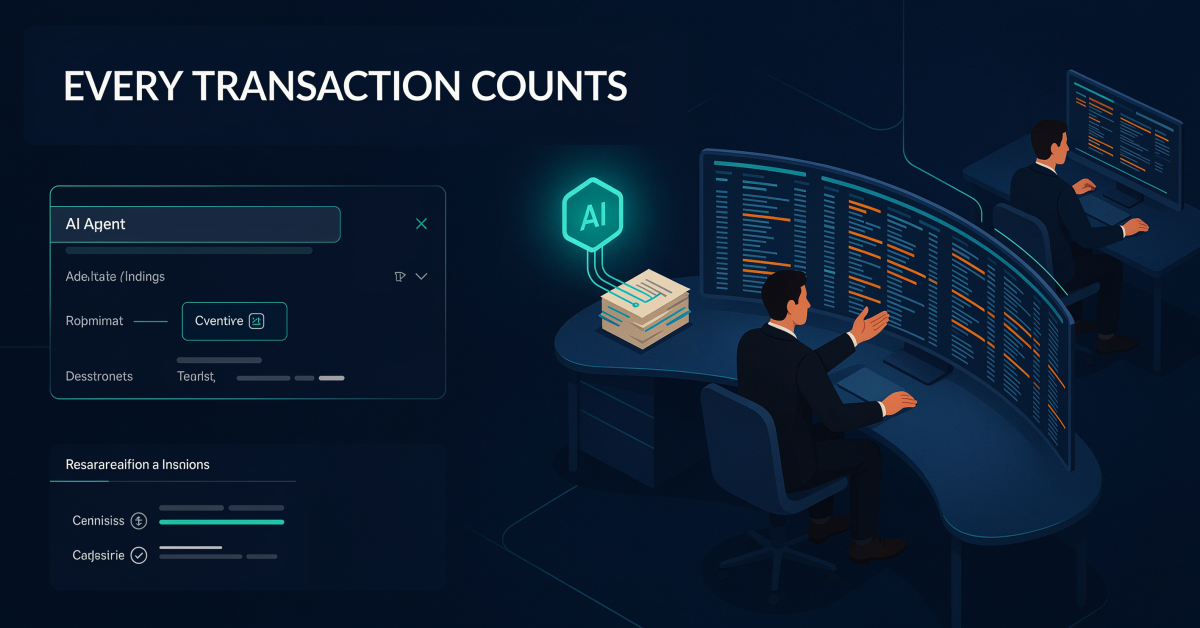
The integration puts MindBridge's transaction-level risk scoring directly inside Fieldguide's engagement environment. Auditors no longer need to pivot between systems to surface anomalies; the risk signals appear in the same workspace where the audit work is being documented and reviewed. Agentic workflows can then act on those signals — routing high-risk findings for additional scrutiny, escalating exceptions, or cross-referencing documentation — without manual handoffs at each step.
That combination — full-population analysis feeding an agentic execution layer — is meaningfully different from an AI tool that summarises or flags after the fact. The risk intelligence is embedded in the process, not appended to it.
The Shift from Sample to Signal
Sampling in audit was never a methodological preference. It was a pragmatic response to the cost of reading everything. When the cost drops toward zero, the argument for sampling weakens significantly — and so does the legal and professional cover it provides.
Full-population analysis surfaces what sampling is statistically designed to miss: low-frequency, high-impact anomalies. A single unusual transaction buried in tens of thousands of routine entries is precisely what sampling tolerates as acceptable risk. Machine learning applied at scale does not tolerate it in the same way. It scores every entry against learned patterns of normal behaviour, and flags divergence regardless of where it sits in the population.
For firms deploying AI-driven monitoring across financial workflows, this is a familiar dynamic. Greater analytical coverage tends to surface more signals, not fewer — and that creates its own challenge: ensuring that human reviewers are focused on the signals that matter, not overwhelmed by volume. The value of an agentic layer is precisely that it can triage, route, and act on signal output without requiring a human decision at every step.
What This Signals for Autonomous Agent Design
The MindBridge–Fieldguide integration illustrates a pattern that is becoming increasingly common in serious AI deployments: specialist intelligence modules feeding into generalised agentic orchestration layers. Neither component alone delivers the full value. The transaction risk scorer without a workflow to act on its output remains a reporting tool. The agentic platform without deep analytical input remains a process shell.
This architecture has implications for any business building or evaluating autonomous agent systems. The question is not only what the agent can do, but what it is reading — and whether the upstream data is comprehensive enough to make its judgments reliable. An agent operating on sampled or incomplete information will make sampled or incomplete decisions, regardless of how sophisticated the reasoning layer is.
An agent operating on incomplete information will make incomplete decisions — regardless of how sophisticated the reasoning layer is.
Governance sits at the same intersection. When an agentic system is acting on full-population financial data, the audit trail of the agent's own decisions becomes as important as the audit trail it is helping to produce. Which signals triggered which actions, under what conditions, reviewed by whom — these are not edge-case compliance questions. They are the core of what makes an autonomous system trustworthy at scale.
The partnership between MindBridge and Fieldguide is a product announcement, but the design principle it reflects is a more durable one: intelligence without execution is a report; execution without intelligence is automation. The combination — grounded, comprehensive, governed — is what distinguishes an autonomous agent from a workflow script.
Further Reading: fintech.global
Ready to Put Agentic AI to Work?
See how autonomous AI agents can handle booking, intake, and follow-up for your business.